

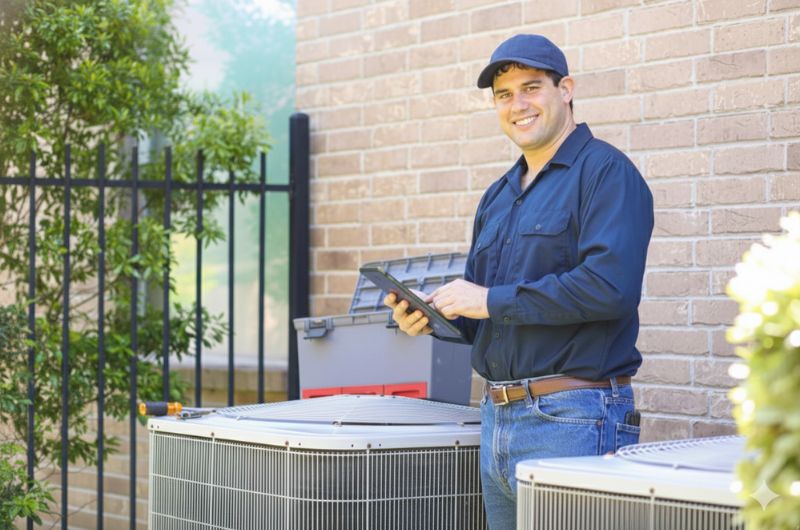
A practical guide for local plumbers, pest control companies, and every other home service business that competes on trust.
Picture this. A pipe bursts under the kitchen sink at 7 PM on a Tuesday. The homeowner grabs their phone, types “plumber near me,” and gets a list of five companies. Four of them have 4.7 stars and dozens of recent reviews. One has 3.2 stars and the last review is from 14 months ago that says, “Never showed up.”
Who do you think gets called?
This isn’t a hypothetical. It’s playing out in every city, every day, in industries from pest control and HVAC to landscaping and electrical work. And the scary part is that most local service business owners have no idea how many jobs they’re quietly losing because their online reputation is working against them instead of for them.
The good news? This is entirely fixable — and AI is making it easier than ever to do it right. In this guide, we’re going to break down exactly why reviews matter so much right now, what happens when you ignore them, and how smart local businesses are using AI tools to build the kind of online reputation that fills their schedules.
The Numbers Are Impossible to Ignore
Let’s start with some hard data, because the scale of what’s happening with online reviews has changed dramatically in just the last couple of years.
According to BrightLocal’s 2026 Local Consumer Review Survey, 41% of consumers now “always” read reviews before choosing a local business — up from 29% just a year ago. That’s not a gradual trend. That’s a shift. And the star rating expectations have gone up right alongside it: 68% of consumers say they won’t use a business with fewer than four stars, compared to 55% just twelve months earlier.
Think about that in terms of your own market. If you’re sitting at a 3.8-star average on Google, the majority of people searching for your services are scrolling right past you — and you may not even know it’s happening.
Other data points worth keeping on your radar:
- 93% of consumers say online reviews influence their purchase decisions. (Chatmeter, 2025)
- One negative review can cost a business up to 30 customers. (ExplodingTopics, 2025)
- 88% of consumers would use a business that responds to all reviews — compared to only 47% who would use one that never responds. That’s a 41-point difference driven entirely by engagement. (ReputationX, 2025)
- Each additional star on Yelp can increase revenue by up to 9%. (ReputationX, 2025)
- Use of ChatGPT and AI tools for local business recommendations jumped from 6% to 45% in a single year, making AI search a new frontier for reputation. (BrightLocal, 2026)
For home service businesses — plumbing, pest control, HVAC, electrical, roofing — these numbers hit especially hard. You’re competing in a high-trust category. People are letting you into their home. Reviews aren’t just marketing fluff. They’re the proof that you’re safe to hire.
“87% of consumers check Google reviews before hiring a pest control company.” — Reputation Genius, 2025
Why Home Service Businesses Have a Unique Reviews Problem
Here’s something that doesn’t get talked about enough: in home services, happy customers almost never go online to brag about their plumber. But frustrated customers absolutely will.
Think about the psychology. When a pest control technician solves a roach problem perfectly, the homeowner feels relief — and then moves on with their life. When a technician shows up late or a callback goes unanswered, that frustration has nowhere to go except a one-star Google review written at 10 PM.
According to Reputation Genius, 65% of pest control reviews are missed during the summer peak season — precisely when technicians are too busy to ask for feedback. You’re doing your best work, and nobody’s capturing it. Meanwhile, your competitors with automated review request systems are quietly stacking up five-star ratings every single week.
There’s also the trust dimension that’s unique to home services. A pest control customer isn’t just evaluating your work — they’re deciding whether to let a stranger into their home with chemicals. A plumber isn’t just fixing pipes; they’re being trusted with access to the most personal spaces in someone’s life. Reviews in this context aren’t just about quality. They’re about safety, reliability, and character.
This is why vague five-star reviews don’t move the needle the way detailed ones do. A review that says “Great service!” is almost meaningless. But one that reads, “Marcus from ABC Plumbing arrived within the hour, clearly explained the issue with our water heater, gave us an honest quote, and had everything fixed before dinner — couldn’t ask for more,” that review closes jobs.
The Hidden Cost of Ignoring Your Online Reputation
Most business owners we talk to underestimate what a bad (or just mediocre) online reputation actually costs them. It’s not just the customers who choose a competitor instead. It’s the compounding effect over time.
You’re invisible in local search
Google’s local algorithm uses review quantity, recency, rating, and response activity as ranking signals. According to Google, online reviews account for 6.47% of local search ranking factors. Businesses in the top three Google Map positions average 47 reviews with consistent, recent activity. If you have 12 reviews and the last one was from eight months ago, you’re starting from a disadvantage before anyone even clicks on your listing.
You’re losing Google Local Services Ads (LSA) performance
If you’re running Google Local Services Ads — the pay-per-lead ads that show up at the very top of search results — your review profile directly impacts your ad ranking and how often Google shows your ad. A stronger reputation means more impressions and lower effective cost per lead. This is a direct, measurable financial hit.
You’re invisible to AI search engines
This one is new and most businesses haven’t caught up yet. AI tools like ChatGPT, Google’s AI Overviews, and other recommendation engines are increasingly being used to find local services. BrightLocal’s 2026 survey found that AI tool usage for local recommendations jumped from 6% to 45% in a single year — making it the third most popular source of business recommendations overall. These AI systems pull from review data, business listings, and online mentions. If your reputation is thin or negative, you won’t surface in these results.
You’re paying more for every lead
Businesses with strong review profiles convert website visitors at dramatically higher rates. When you’re spending money on ads or SEO to drive traffic, your cost per booked job goes up if your reputation isn’t doing its job on the back end. According to Textedly, positive reviews can increase conversion rates by up to 370%. That number sounds inflated until you think about it: would you call a plumber with 200 reviews and 4.8 stars or one with 8 reviews and 3.9?
What Good Reputation Management Actually Looks Like
Before we talk about AI, it’s worth being clear about what a solid reputation management strategy involves, because plenty of business owners think this just means asking for reviews sometimes. It’s quite a bit more than that.
1. Consistently generating new reviews
Recency matters. A flood of five-star reviews from two years ago and nothing recent sends a signal — and not a good one. Consumers want to know that the experience they’re reading about is what they’ll actually get today. BrightLocal found that consumers are using an average of six review platforms in 2026, which means your presence needs to be consistent and current across Google, Yelp, Facebook, Angi, and industry-specific platforms.
The single most effective way to get more reviews: ask at the right moment. For a pest control company, that moment is right after a successful initial treatment — not three weeks later when the customer has moved on. For a plumber, it’s the text you send an hour after the job is done, while the customer is still feeling the relief of a fixed problem. According to Chatmeter, 65% of consumers who are asked to write a review write a more positive one. The ask itself matters.
2. Responding to every single review
This is the one area where most local businesses fall completely flat. And it’s costing them. BrightLocal’s 2026 survey found that 89% of consumers expect a response to their reviews. Nineteen percent expect one the same day. And yet most small businesses either never respond or do so days or weeks later.
Here’s what business owners miss: when you respond to a review, you’re not just talking to the person who wrote it. You’re speaking to every future customer who reads that thread. A thoughtful, professional response to a negative review can actually increase trust more than a string of positive ones. It shows accountability. It shows that a real human being is paying attention.
The reverse is equally true. Ignoring a bad review — or responding defensively — is one of the fastest ways to turn a bad situation into a reputation crisis.
3. Monitoring across platforms
Customers leave reviews everywhere. Google is still number one — 83% of US consumers use it to evaluate local businesses according to Backlinko — but Yelp, Facebook, Angi, HomeAdvisor, NextDoor, and even Nextdoor neighborhood groups all matter for home service companies. A one-star review on Angi that goes unanswered for three weeks is doing quiet damage to your lead volume.
4. Intercepting negative feedback before it goes public
A callback issue, a scheduling mix-up, a tech who ran late — these things happen in every service business. The question is whether the customer’s frustration gets resolved privately or gets turned into a public one-star review. Proactive check-ins after service, a simple “How did we do?” text that routes unhappy customers to a direct conversation before they hit Google — these systems save reputations.
Where AI Comes In — and Why It Changes Everything for Small Service Businesses
Here’s the honest problem with everything described above: it takes time, consistency, and attention. A plumbing company owner is running a crew, handling scheduling, dealing with supply chain issues, and trying to grow the business. Manually asking for reviews after every job, monitoring six platforms, and crafting individual responses to every review isn’t realistic without help.
This is where AI-powered reputation management tools have become a genuine game-changer for local service businesses. Not in a hype-y, buzzword way — but in a genuinely practical, time-saving way that directly affects revenue.
Automated Review Requests at the Right Moment
AI-connected reputation platforms integrate with your CRM or field service software — think ServiceTitan, Jobber, PestRoutes, or Housecall Pro — and automatically trigger a review request via text or email after each completed job. No manual steps required. The timing is optimized (typically within 1-2 hours of job completion), the message is personalized, and the link goes directly to your Google review page.
The results are real. Reputation Genius documented a pest control company that went from 45 reviews accumulated over years to 200+ reviews in just three months after implementing automated review requests — and reported a significant increase in inbound calls from Google Maps as a direct result.
AI-Generated Review Responses That Sound Human
Responding to 50 reviews a month manually is a real time commitment. AI tools can now draft contextually appropriate, personalized responses to reviews across all platforms — and they do it in your business’s voice, not in the robotic “Thank you for your feedback” language that consumers have learned to see right through.
Better AI platforms incorporate local SEO best practices into review responses, naturally including your service area, the specific service performed, and relevant keywords — which actually helps your Google ranking over time.
Sentiment Analysis and Early Warning Systems
Advanced AI reputation tools analyze patterns across all your reviews — not just the star rating, but the actual language customers use. Are multiple people mentioning that your tech was late? Is “callback” showing up repeatedly in negative reviews? This kind of sentiment analysis turns your review data into operational intelligence that tells you where your business process needs attention.
Some platforms also flag negative reviews in real time and alert the business owner immediately, making it possible to respond within hours — which is increasingly what customers expect. BrightLocal found that 32% of consumers want a response by the following day and 19% expect one the same day the review is posted.
Negative Feedback Interception Before It Goes Public
Some AI tools include a feedback funnel that routes post-service check-ins so that dissatisfied customers are directed to a private resolution channel rather than straight to Google. A frustrated customer who gets a personal call from the owner to make things right is far less likely to leave a one-star review than one who got a generic survey link.
A Real-World Scenario: What This Looks Like for a Pest Control Company
Let’s put all of this in practical terms with a scenario.
Greenfield Pest Control is a regional company operating in three markets. Before implementing AI-powered reputation management, they had 67 Google reviews across their three locations, averaging 4.1 stars. Their biggest issues: no review requests were being sent consistently, they were responding to maybe 30% of reviews (usually the negative ones), and they had no visibility into what customers were saying on Yelp or Angi.
After integrating an AI reputation platform with their PestRoutes CRM:
- Every completed job triggered an automated, personalized review request within 90 minutes. Text message open rates for review requests are typically 5-10x higher than email.
- AI-drafted responses went out to 100% of reviews within 24 hours, approved by the office manager in a quick daily queue.
- Sentiment analysis flagged a pattern: several customers in one market mentioned “bugs returned after treatment” — which led to a service protocol adjustment.
- A negative feedback interception system caught two unhappy customers who were routed to a direct call with the owner rather than to Google.
Within six months: review volume tripled, average star rating climbed to 4.7, and inbound calls from Google Maps increased by roughly 40%. The business didn’t change its service — it just started systematically capturing evidence of the good work it was already doing.
Practical Steps You Can Take This Week
You don’t need to overhaul everything overnight. Here’s where to start:
Audit your current position
Search your business name on Google, Yelp, Facebook, and Angi. Count your reviews, note your average rating, and check when the last review was posted. This is your baseline. If you don’t know what your reputation looks like, you can’t fix it.
Claim and complete all your business profiles
A Google Business Profile with photos, updated hours, service categories, and a description isn’t optional — it’s the foundation of your local reputation. Apple Maps has nearly doubled in consumer usage in the past year (from 14% to 27% according to BrightLocal). If you haven’t claimed your Apple Business Connect profile, do it today.
Start asking — manually at first if you need to
Even before you have automation in place, you can start texting happy customers a direct link to your Google review page. Keep it simple: “Hi [Name], thanks again for letting us handle your [service]. If you have a minute, we’d really appreciate a Google review — it helps families in [your town] find a trustworthy [plumber/pest company/etc.]: [link]” That’s it. The ask alone will start moving the needle.
Respond to every review starting today
Set a daily 10-minute calendar block. Read through new reviews, thank the positive ones personally (don’t copy-paste the same response), and acknowledge negative ones professionally. When you reply to a negative review, use this framework: acknowledge the issue without being defensive, apologize for the experience, offer to make it right offline, and provide contact information. Never argue in a review thread.
Invest in automation when you’re ready to scale
Once you’ve got the manual process working, it’s time to put it on autopilot. AI-powered reputation management platforms specifically built for home service businesses — many of which integrate directly with field service CRMs — can take over the entire workflow. Look for platforms that offer review request automation, multi-platform monitoring, AI response drafting, sentiment analysis, and integration with your existing software.
A Word About Fake Reviews — Don’t Even Think About It
It’s worth addressing this directly, because some businesses under reputation pressure are tempted to buy reviews or have staff post fake ones. Don’t. The FTC banned fake and AI-generated reviews in August 2024, and the penalties are significant. More practically: 83% of consumers say they would avoid a business they discovered was using fake reviews, according to Backlinko. Consumers are increasingly good at spotting them — generic language, no profile history, reviews posted in a suspicious cluster all set off alarm bells.
The strategy described in this article — generating real reviews at scale from real customers through smart automation — is both more sustainable and more effective than any shortcut. There’s no substitute for earned trust.
The Bottom Line
Your online reputation isn’t a side project. For a local plumber, pest control company, HVAC tech, or any other home service business, it is the front door to every potential customer you’ll ever have. Before someone calls your number, they’ve already made a judgment about your business based on what they read online.
The businesses that understand this — and that build systems to manage it proactively instead of reactively — are going to keep winning the jobs. The ones that don’t are going to keep wondering why their competitors’ phones are ringing more.
The technology to do this right has never been more accessible, more affordable, or more effective for small local service businesses. AI-powered reputation management isn’t something only enterprise chains can afford anymore. It’s table stakes for any home service business that wants to grow.
Start where you are. Audit your reviews today. Ask your next happy customer for one tonight. Respond to the one that’s been sitting unanswered for three weeks. Then build from there.
Your reputation is being built whether you’re managing it or not. The only question is whether you’re in the driver’s seat.
A Real Example From My Own Business — And Why It Changed How I Think About Reviews
I want to share something that happened at my own salon, Gloss & Glam Hair Salon and Head Spa in Los Angeles, because it’s the moment that truly crystallized everything I’m describing in this article.
My partner, Lida, is a master colorist and specializes in complex highlighting work — the kind of multi-step, hours-long color transformation that clients are genuinely nervous about trusting to someone new. Highlights, especially corrective color, are high-stakes. A client who’s had a bad experience before is going to do her homework before she sits in anyone’s chair.
A new client came in and booked specifically with Lida for a complicated highlight appointment. When I asked how she found us, she said she had been reading Google reviews — and that what made her choose Lida wasn’t just the star rating. It was a review that included actual before-and-after photos of a previous client’s hair. She could see the starting point (brassy, uneven color) and the result (beautiful, dimensional highlights). She saw the transformation with her own eyes before she ever walked through our door.
That one photo-backed review did something no ad, no Instagram post, and no discount offer could do: it eliminated the risk in her mind. She wasn’t just reading that Lida was good — she was seeing proof. And she booked.
Think about what that means for any service business. The landscaping customer who wants to see a photo of a treated home, before and after. The plumber who has a client leave a review with a photo of the clean repair job next to the disaster they walked into. These aren’t just nice extras — they’re the visual proof that makes a skeptical customer pick up the phone.
That experience at Gloss & Glam is a big part of what drove me to build Vybrant AI. I saw firsthand that the right review, at the right moment, with the right content, doesn’t just build reputation — it directly books business. I wanted to build a tool that makes capturing those moments automatic for every local service business, not just the ones with a marketing team.
She didn’t book because of our star rating. She booked because she saw real proof — a real client, real results, right there in a Google review. That’s the difference between a review that gets read and a review that gets someone to act.
About the Author
Shawn Shayestehfar
Founder, Vybrant AI | Co-Owner, Gloss & Glam Hair Salon and Head Spa, Los Angeles
Shawn Shayestehfar is the founder of Vybrant AI and the co-owner of Gloss & Glam Hair Salon and Head Spa, a luxury salon and head spa in Los Angeles. As a small business owner in one of the most competitive service markets in the country, Shawn has lived the challenges of local reputation management firsthand — watching reviews influence which stylist a client books, seeing how a single photo-backed review can convert a hesitant customer, and understanding the gap between the quality of service a small business delivers and the online presence it’s able to maintain without the right tools.
That firsthand experience is what led Shawn to build Vybrant AI — a platform designed specifically to help local service businesses take control of their online reputation, generate more authentic reviews, and turn customer feedback into a consistent source of new business. Vybrant AI was built by a small business owner who knows what it actually takes to compete locally, not by a team that has only seen the problem from the outside.