
A complete guide to AI-powered customer support tools — auto-replies, virtual assistants, and ticketing systems — written for small business owners who want real answers without the tech jargon.
Here is a number that should stop every small business owner cold: 67% of customers have switched brands after a poor customer service experience — even when the product itself was perfectly fine. Not because you did bad work. Not because your price was wrong. Because the service experience around your work let them down. (Yaguara, 2026)
For a small business operating without a dedicated support team, this is a silent killer. Customers send a message, wait too long, and leave. An inquiry comes in at 9 PM and sits until 9 AM. A repeat customer sends the same question they asked six months ago because no one tracked it. These aren’t dramatic failures. They’re small friction points that compound over time into lost revenue and a reputation that quietly erodes.
The good news is that in 2026, solving this problem no longer requires hiring a customer service team. AI-powered customer service tools — including auto-reply systems, AI virtual assistants, and automated ticketing — have become genuinely accessible to businesses of any size, at price points that make financial sense even for a solo operator.
This guide covers everything a small business owner needs to know: what AI customer service tools actually do, how much they cost, what kind of results to realistically expect, and how to get started without needing a tech background.
What Is AI Customer Service — And Why Should Small Businesses Care?
AI customer service refers to any technology that uses artificial intelligence to handle customer interactions automatically — answering questions, routing issues, sending follow-ups, booking appointments, and resolving complaints — without requiring a human to be available in real time.
For small businesses, this matters for one fundamental reason: you are competing against companies with dedicated support teams, and customers don’t adjust their expectations based on your size. They expect fast responses whether they’re contacting a solo plumber or a national chain. According to the 2026 Salesmate customer service report, 46% of customers expect a reply within four hours, and 63% rank response speed as the single most important factor in a good service experience. Speed matters more than price, more than politeness, and more than almost anything else.
AI customer service tools close this gap. They don’t need sleep, they don’t take lunch breaks, and they don’t call in sick on your busiest Monday. When properly set up, they respond to customer inquiries in seconds — not hours — and handle the majority of routine questions without any human involvement at all.
The scale of adoption tells you which way this is moving: in 2020, only 5% of customer service teams used AI-powered tools. By 2025, that number exceeded 80%. That is a 16x increase in five years — one of the fastest adoption curves in the history of business technology. (Gartner, via ChatMaxima) The businesses that move now are building systems their competitors will spend years catching up to.
“First response time for customer tickets has dropped from over 6 hours to less than 4 minutes with AI-powered support.” — Freshworks CX Benchmark Report, 2025
The 3 Core AI Customer Service Tools Every Small Business Should Know
There are dozens of ways AI is being applied to customer service, but for small businesses, three tools deliver the clearest, fastest return. Understanding what each one does — and doesn’t do — is the starting point for building a system that actually works.
1. AI Auto-Reply Systems
An AI auto-reply system uses artificial intelligence to read incoming messages — whether via email, text, social media DM, or website chat — and send a relevant, personalized response automatically. Unlike the basic auto-replies of a decade ago (“Thanks for your message, we’ll get back to you within 2 business days”), modern AI auto-replies actually answer the question.
If a customer texts your salon asking whether you have availability Saturday morning, an AI auto-reply system doesn’t send a holding message — it checks your calendar and either confirms an opening or explains that Saturday is fully booked and suggests the next available time. If a customer emails your pest control company asking what products you use and whether they’re pet-safe, the AI answers that specific question accurately, based on the information you’ve trained it on.
The result: customers get real answers instantly, at any hour, and your team isn’t burning time on repetitive correspondence. AI-powered systems have cut first response time by up to 74% within the first year of implementation. (Freshdesk, via ChatMaxima, 2026)
2. AI Virtual Assistants (24/7 Customer Support Bots)
An AI virtual assistant is a conversational tool — typically deployed on your website, social media profiles, or messaging apps — that holds full back-and-forth conversations with customers in real time. It can answer questions, collect information, guide customers through service options, and hand off to a human when a situation genuinely requires it.
The distinction from a basic chatbot is important. A basic chatbot follows a script — it can only respond to questions it was explicitly programmed for. An AI virtual assistant understands natural language, meaning it handles questions phrased in dozens of different ways and maintains context throughout a conversation. If a customer says “Actually, forget Saturday — what about next Tuesday?” the AI understands they’re continuing a scheduling conversation, not starting a new one.
According to desk365.io’s 2026 data, AI virtual assistants now deflect up to 80% of routine customer inquiries without any human involvement. For a small business fielding 30-50 customer contacts per day, that means your team only needs to personally handle 6-10 of them — the genuinely complex or sensitive ones where a human touch matters.
3. AI Ticketing and Customer Support Management
When customer inquiries come in across multiple channels — email, text, social media, website chat, phone — keeping track of them manually is a recipe for things falling through the cracks. AI ticketing systems collect every incoming customer contact, regardless of channel, into a single organized inbox. The AI then reads each inquiry, categorizes it by topic and urgency, drafts a suggested response, and routes it to the right person if human handling is needed.
For small businesses, this solves one of the most common and costly service failures: the inquiry that gets lost. The DM that nobody saw. The email that slipped to the bottom of a busy inbox. The voicemail that got transcribed but never followed up on. AI ticketing makes sure nothing disappears — and it surfaces urgent issues immediately rather than letting them age.
AI-assisted agents who use ticketing tools resolve customer issues 47% faster and achieve 25% higher first-contact resolution rates compared to teams without automation. (Fullview, 2026) For a small team, this means fewer follow-up contacts, fewer repeat complaints, and more time for the work that actually generates revenue.
The Real Numbers: What AI Customer Service Actually Delivers
Enough with the features — what does AI customer service actually produce for a real business? The data across hundreds of implementations tells a consistent story.
Response time: from hours to seconds
This is the most immediate and measurable impact. AI-enabled companies respond to customer inquiries in an average of 10 seconds. Their non-AI competitors take 4 hours or more. (Freshworks, 2025) One specific deployment documented by Freshdesk shows AI slashing first response time from 12 minutes to 12 seconds — a 98% reduction. At that speed, customers aren’t wondering if you received their message. They already have an answer before they’ve put their phone down.
Resolution time: from days to minutes
Beyond the first response, AI dramatically compresses how long it takes to fully resolve a customer issue. Freshworks’ benchmark data shows resolution times dropping from nearly 32 hours to 32 minutes in AI-enabled deployments. For home service businesses — where a customer waiting on a quote, a confirmation, or a callback answer can easily call a competitor in the meantime — this kind of speed is a direct competitive advantage.
Cost reduction: 30-50% less to run customer support
IBM research documents a 30-50% reduction in customer service operational costs for businesses that implement AI. At the task level, each AI-handled interaction costs between $0.25 and $0.50, compared to $3 to $6 for a human-handled one — an 85-90% per-interaction cost reduction. (NextPhone, 2026) For a small business handling 500 customer contacts per month, that gap is significant even at modest volumes.
Customer satisfaction: counterintuitively, it goes up
One of the most common fears about AI customer service is that customers will hate it. The data says otherwise — when done right. Businesses that implement AI support see customer satisfaction scores climb from 89% to 99% on average. (Freshworks, 2025) And 92% of businesses report improved customer satisfaction after adding AI chatbots. (Dante AI, via ChatMaxima) The reason is simple: customers don’t care whether a human or an AI answered them. They care whether they got a fast, accurate, helpful answer. AI delivers that consistently.
The important caveat: this is true for routine inquiries. For complex complaints, sensitive situations, or anything requiring genuine empathy and judgment, customers still strongly prefer a human. The businesses that get the best results from AI customer service use it to handle the routine 70-80% of interactions, freeing their human team to focus exclusively on the cases where human judgment actually matters.
ROI: $3.50 back for every $1 invested
The aggregate return on AI customer service investment averages $3.50 for every $1 spent, with leading implementations achieving up to 8x ROI. (People Matters Global, via Fullview) The payback period is typically 3-6 months — meaning most small businesses recover their entire investment before the end of the first year, then operate in pure profit on the tool going forward.
“67% of customers have switched brands due to poor customer service — even when the product itself was fine. AI closes the gap between the quality of your work and the quality of your customer experience.” — Shawn Shayestehfar, Founder, Vybrant AI
What This Looks Like in a Real Small Business
I want to walk through this concretely, because the difference between understanding AI customer service in theory and seeing how it plays out in an actual small business is significant.
At Gloss & Glam Hair Salon and Head Spa in Los Angeles, customer inquiries come in through multiple channels simultaneously: Instagram DMs, Google Business messages, our website chat, text messages to our main number, and phone calls. For a team focused on doing great work behind the chair, managing that volume of communication consistently — especially during busy stretches and after hours — was a real operational challenge.
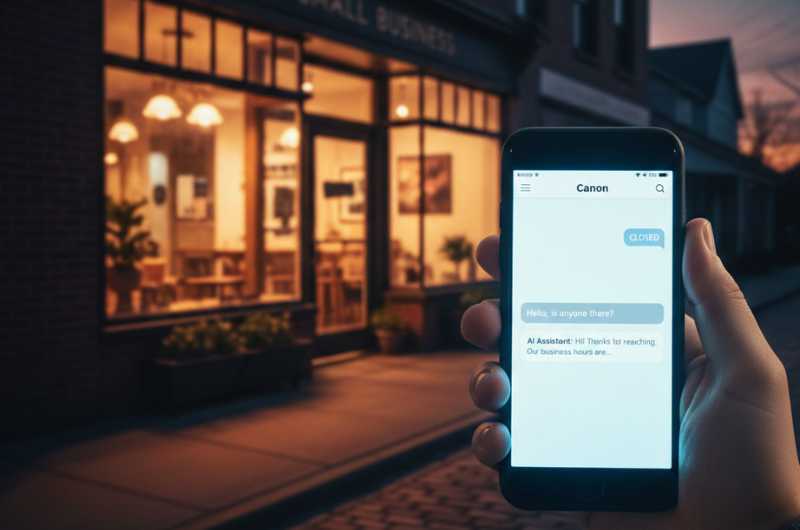
The pattern we kept seeing: a potential client would message on a Saturday evening asking about availability or pricing for a color service. By Sunday morning, that message was still sitting unanswered. Some of those clients had already booked somewhere else by the time we replied. We weren’t ignoring them deliberately — we were simply not staffed for 24/7 communication. But from the client’s perspective, an unanswered message looks the same whether it was ignored or just unseen.
After implementing AI auto-reply and a virtual assistant trained on our service menu, stylist specialties, pricing, and availability logic, the after-hours gap essentially closed. A client messaging at 10 PM on a Saturday asking whether Lida has availability for a balayage appointment gets an accurate, helpful response within seconds — either confirming an opening, suggesting alternatives, or letting them know the next available slot. By the time Monday morning arrives, those clients aren’t lost leads. They’re confirmed bookings.
The thing that surprised me most wasn’t the time savings — it was how much better the client experience felt. Clients told us they appreciated getting a fast answer. Nobody complained about talking to an AI. Because from their side, they got what they needed quickly, which is all they were ever asking for.
That experience is exactly what informed the tools we built into Vybrant AI — because I know firsthand that the service gap most small businesses have isn’t about the quality of their work. It’s about the communication layer around that work. AI closes that gap in a way that actually improves the client experience rather than making it feel colder or more automated.
The Human Element: Where AI Stops and Your Team Should Take Over
One of the most important things to be clear about with AI customer service is what it should not handle. Getting this wrong is one of the primary reasons AI implementations fail and customers feel frustrated.
The data is unambiguous: 80% of consumers still expect to be able to reach a human when they contact a business. (AmplifAI, 2026) And 50% of customers say they would cancel a service entirely if it was solely AI-driven with no human option. (Kinsta, 2025) Customers are not rejecting AI — they’re rejecting the feeling of being trapped in an automated system with no exit.
A well-designed AI customer service system is one where the AI handles the 70-80% of interactions that are routine, and a clear, easy path to a human exists for the rest. The situations where your team should always be involved:
- Formal complaints or situations where a customer is upset — these require genuine empathy that AI cannot authentically provide.
- Complex, custom, or unusual requests that fall outside your standard service parameters.
- High-value clients or situations where a personal touch is part of your brand promise.
- Any situation where the AI indicates it is uncertain or cannot adequately help — these should always escalate automatically.
The businesses that get this balance right — AI for speed and volume, humans for complexity and emotion — are the ones achieving 99% customer satisfaction scores. The ones that try to replace their human judgment entirely with AI are the ones creating the frustrated customer experiences that damage reputations.
How to Choose the Right AI Customer Service Tool for Your Small Business
The market for AI customer service tools ranges from free-tier chatbots to enterprise platforms costing thousands per month. For a small business, the decision comes down to a handful of practical factors.
What channels do your customers actually use?
Before choosing any tool, audit where your customers are actually reaching you. If 60% of your inquiries come through Instagram DMs and your website only gets 10%, a tool that only covers website chat isn’t solving your real problem. Look for platforms that handle your highest-volume channels first — whether that’s SMS, Instagram, Facebook Messenger, Google Business messages, email, or website chat.
Does it integrate with the tools you already use?
An AI customer service tool is dramatically more useful when it connects to your existing systems. For a salon, that means integrating with your booking software so the AI can actually check real-time availability. For a pest control company, it means connecting to your field service platform so the AI can quote service areas and scheduling windows accurately. A standalone chatbot that can’t talk to your existing software is limited to FAQ-style responses — useful, but a fraction of what an integrated system can do.
Is the AI good enough to represent your brand?
Not all AI is equal. Rule-based systems that follow decision trees feel robotic within two exchanges. Large language model-based tools (the same technology behind ChatGPT) handle natural conversation far more capably. Ask vendors specifically whether their tool uses LLM technology, ask for a demo using realistic customer questions from your business, and pay attention to how it handles questions it wasn’t specifically trained for. A graceful “Let me connect you with our team for that one” is far better than a confused, looping response.
What does it actually cost — and what’s the break-even?
For small businesses, quality AI customer service tools are available in a range from free starter tiers to $30-200 per month for robust small business plans. The break-even math is usually fast: if your average transaction value is $100-300 and the AI helps convert just three to five additional inquiries per month that would otherwise have gone unanswered, the tool pays for itself within the first month. Run that calculation with your own numbers before comparing price tags.
Getting Started: What to Do in the First 30 Days
The most common reason small businesses delay AI customer service implementation is the assumption that setup will be complicated and time-consuming. In most cases, a functional deployment takes days, not weeks. Here is a practical roadmap:
- Days 1-3: Map your current customer communication. Write down every channel through which customers reach you, estimate how many messages per day or week you receive on each, and list the 15-20 questions you answer most frequently. This inventory is both your setup guide and your training data.
- Days 4-7: Choose and set up your platform. Select a tool that covers your primary channels and integrates with your booking or CRM system. Most small business AI platforms can be configured in a few hours using no-code setup processes — you are essentially describing your business in plain language, not writing code.
- Days 8-14: Test before you go live. Spend a week sending test messages from a personal device across every channel. Try to break it — ask unusual questions, follow unexpected conversation paths, and see how it handles escalation. Fix the gaps before real customers encounter them.
- Days 15-30: Launch and monitor closely. Go live and review every AI conversation daily for the first two weeks. You will discover questions you didn’t anticipate, phrasings that confuse the system, and opportunities to improve. This refinement period is where the real quality is built. Most systems improve significantly with two to three weeks of active attention.
After 30 days, most small businesses have a system that handles 60-80% of customer inquiries automatically, with a clear escalation path for the rest. The daily maintenance time drops to 15-20 minutes of reviewing conversations and occasional training updates. That is a small business’s version of a full-time customer service operation — without the full-time payroll.
Poor Customer Service Is a $3.8 Trillion Problem — And AI Is the Fix Small Businesses Can Actually Afford
Globally, poor customer service puts $3.8 trillion in revenue at risk annually. (Salesmate, 2026) That number is staggering at the macro level, but at the individual small business level, it translates to something more immediate and personal: the client who texted you on Sunday and booked with someone else by Monday. The customer whose complaint sat in your inbox for three days and left a one-star review. The lead that bounced from your website at 11 PM because nobody was there to answer one simple question.
These are not inevitable losses. They are preventable ones. And in 2026, preventing them doesn’t require hiring staff you can’t afford or being available around the clock in ways that aren’t sustainable. AI customer service tools handle the volume, maintain the speed, and capture the opportunities — so your team can focus on the work that actually requires a skilled human being.
The adoption curve is steep and moving fast. The businesses that set up strong AI customer service systems now are building a structural advantage that will compound over the next few years. The ones waiting for the technology to mature further are already behind — because from a customer’s perspective, that bar has already been raised. They’ve experienced fast, helpful, 24/7 AI interactions with businesses that got there first. Now they expect it from everyone. Including you.
Frequently Asked Questions About AI Customer Service for Small Business
What does AI customer service mean for a small business?
AI customer service for a small business means using artificial intelligence tools to automatically respond to customer inquiries, answer frequently asked questions, book appointments, categorize and route support tickets, and follow up with customers — all without requiring a human to be available in real time. For small businesses, this typically means deploying a combination of AI auto-replies, a virtual assistant on your website or social channels, and a centralized inbox that organizes all customer contacts regardless of channel.
How fast can AI respond to customer messages?
Top AI customer service platforms respond to incoming messages in approximately 10 seconds or less. Freshworks’ 2025 benchmark data documents first response times dropping from over 6 hours to under 4 minutes across all AI-using businesses — and to 10-12 seconds among top performers. This compares to an industry average of 4+ hours for businesses without AI. For customers who rank speed as the number one factor in their service experience, this difference is significant.
How much does AI customer service cost for a small business?
AI customer service tools for small businesses range from free starter tiers to approximately $200 per month for fully featured platforms. Basic chatbot and auto-reply functionality is available at the low end. Platforms with multi-channel coverage, booking integration, CRM connectivity, and AI ticketing typically run $50-150 per month for small business plans. For context, each AI-handled customer interaction costs $0.25-$0.50, compared to $3-$6 for a human-handled one — meaning the platform usually pays for itself after a small number of deflected contacts per month.
Will customers be frustrated dealing with AI instead of a person?
Customer frustration with AI support comes from poor implementation — bots that give wrong answers, can’t handle natural language, or provide no path to a human. When AI is well-configured and backed by a clear escalation option, customer satisfaction scores actually improve. Businesses that implement AI support well report CSAT scores climbing from 89% to 99% on average. (Freshworks, 2025) The key requirements: train the AI thoroughly on accurate business information, set boundaries on what it handles, and always offer easy human escalation for complex or emotional situations.
What percentage of customer inquiries can AI handle without a human?
Well-implemented AI customer service systems typically handle 65-80% of customer inquiries without any human involvement. Freshworks data from 2025 shows AI agents deflecting over 45% of incoming queries in average deployments, with retail and service businesses seeing deflection rates above 50-70%. Top-performing implementations using strong AI and thorough training regularly exceed 80%. The remaining 20-35% — the complex, sensitive, or unusual situations — escalate to a human team member.
Can AI customer service tools work on Instagram, Facebook, and text messages — not just my website?
Yes — modern AI customer service platforms are built for omnichannel deployment, meaning they cover multiple communication channels from a single system. Most quality platforms support website chat, SMS/text, Instagram DMs, Facebook Messenger, WhatsApp, Google Business Messages, and email. For small businesses that receive a high volume of inquiries through social media — which is increasingly common for salons, restaurants, fitness studios, and local service companies — this cross-channel coverage is essential. A tool that only covers your website misses a significant share of your actual inquiry volume.
Do I need technical skills to set up AI customer service?
No technical skills are required for most modern AI customer service platforms designed for small businesses. Setup involves describing your business, services, pricing, and common questions in plain language — not writing code or managing servers. Most small businesses can have a functional AI customer service system live within two to five business days. The main investment is time spent compiling your FAQ content and service information, not technical work.
What is an AI ticketing system and does my small business need one?
An AI ticketing system collects every customer inquiry — from every channel — into one organized inbox, then uses AI to categorize each inquiry by type and urgency, draft a suggested response, and route it appropriately. For a small business receiving inquiries from email, text, social media, and website simultaneously, it prevents the most common service failure: messages falling through the cracks. If you regularly receive 20 or more customer contacts per day across multiple channels, an AI ticketing system will immediately reduce your response times and the number of inquiries that go unaddressed.
How is AI customer service different from a regular chatbot?
A traditional chatbot follows a fixed script — it can only respond to questions it was explicitly programmed for, and it fails the moment a customer phrases something differently or asks an unexpected question. AI customer service tools use large language model technology to understand natural language, meaning they handle varied phrasing, maintain context through a conversation, and can reason through questions they weren’t specifically trained for. The practical difference: a traditional chatbot frustrates customers within two exchanges. A well-built AI customer service tool handles most conversations from start to finish without feeling robotic.
What is the ROI of AI customer service for a small business?
The average return on AI customer service investment is $3.50 for every $1 spent, with leading implementations achieving up to 8x ROI. (People Matters Global, via Fullview) The typical payback period is 3-6 months. For small businesses, ROI comes from three sources: direct cost savings from reduced manual communication time, additional revenue from leads that would otherwise have been lost to slow response, and customer retention improvement from consistently faster, higher-quality service. Running your own numbers: multiply your daily average inquiry volume by the percentage you expect AI to handle, then multiply that by your hourly labor cost per inquiry to estimate direct savings alone.
About the Author
Shawn Shayestehfar
Founder, Vybrant AI | Owner, Gloss & Glam Hair Salon and Head Spa, Los Angeles
Shawn Shayestehfar is the founder of Vybrant AI and owner of Gloss & Glam Hair Salon and Head Spa in Los Angeles. Having built and operated a luxury service business in one of the country’s most competitive markets, Shawn has experienced firsthand how the gap between great service delivery and inconsistent customer communication quietly costs small businesses revenue and reputation. Vybrant AI was built to close that gap — bringing enterprise-grade AI customer service, review management, and lead capture tools to small businesses that compete on quality, not headcount.
Sources
Freshworks, CX 2025 Benchmark Report. freshworks.com
ChatMaxima, 55+ AI Customer Support Statistics and Trends for 2026. chatmaxima.com
Desk365, 61 AI Customer Service Statistics in 2026. desk365.io
NextPhone, 75 AI Customer Service Statistics 2026. getnextphone.com
Fullview, 80+ AI Customer Service Statistics & Trends in 2025. fullview.io
SurveyMonkey, Customer Service Statistics 2026: Humans vs AI. surveymonkey.com
Salesmate, 65+ Customer Service Statistics & Trends You Should Know in 2026. salesmate.io
IBM, AI in Customer Service Cost Reduction Analysis. ibm.com
People Matters Global, AI ROI in Customer Service. peoplematters.in
Gartner, AI Customer Service Adoption and Projections. gartner.com
Yaguara, Customer Experience and Retention Statistics 2026. yaguara.co
AmplifAI, Customer Expectation and Human-AI Preference Data, 2026. amplifai.com