

Google search looks completely different than it did two years ago. Here is what changed, why your website traffic may have dropped, and what small businesses need to do right now to stay visible — and keep getting customers.
Something big changed in how Google works. And if you have noticed fewer people finding your website lately, this is probably why.
Google used to work like a library. You typed something in, it gave you a list of ten websites, and you picked one to click. Simple. That’s how it worked for twenty years.
Now Google uses AI — artificial intelligence — to read all those websites and write its own answer right at the top of the page. No clicking required. The answer is just there. Google calls this feature AI Overviews.
For small businesses, this changes a lot. The old way of getting found online is not completely dead — but it is not enough on its own anymore. The good news is that the businesses that understand what is happening right now have a real advantage over the ones still playing by the old rules.
This guide will explain exactly what changed, what it means for your business, and why getting the right help now matters more than ever.
What Is Happening to Google Search Right Now?
Think of it this way. You walk into a library and ask the librarian where to find books about plumbing. The old librarian pointed you to the shelves and let you find a book yourself. The new AI librarian just answers your plumbing question on the spot — and you never need to visit the shelves at all.
That is what Google is doing now. When someone searches for something, Google’s AI reads the top websites on that topic and writes a summary answer right at the top of the page. This is called an AI Overview. It appears before any website links. Before any ads. Before anything.
The numbers are staggering. As of late 2025, AI Overviews appear on 30% of all Google searches on desktop computers — and on mobile phones, the number grew by nearly 475% in a single year. (Semrush, 2026) Two billion people every month are seeing AI-generated answers at the top of their Google search results. (SEOmator, 2026)
And here is what that means for websites: when an AI Overview appears on a search page, organic click-through rates — the percentage of searchers who actually click a website link — have dropped by 61%. (Seer Interactive, 2025) People get their answer from Google’s AI and never visit any website at all.
In 2026, around 60% of all Google searches end without a single click. (AIOSEO, 2026) More than half of the people searching for things your business offers never visit any website. They just read what Google’s AI tells them and move on.
“60% of all Google searches in 2026 end without a single click to any website. The game has changed — and most small businesses don’t know it yet.”
Is This Bad for My Small Business?
Not necessarily — but only if you understand what is happening and adjust. Here is the important distinction that most people miss.
Local service businesses — your plumber, your hair salon, your pest control company, your HVAC technician — are actually in a much safer position than most. Here is why.
Google’s AI Overviews appear mainly for general information searches. Things like “how does a water heater work” or “what causes roaches in a clean house.” They appear very rarely for searches where someone is trying to find and hire a local business. In fact, only 7.9% of local searches trigger an AI Overview at all. (Ahrefs, 2025)
When someone types “pest control company near me” or “best hair salon in Los Angeles” or “plumber available today,” Google knows they want a real business to hire — not a written summary. So it shows local map listings, business profiles, reviews, and website links. The kind of results where your business can still show up front and center.
But here is where it gets complicated. Getting into those local results — and staying there — has changed significantly. It is no longer enough to just have a website. Google is now looking at your business from every angle. How many reviews you have. How recently they were written. Whether your business information is consistent everywhere online. Whether your website loads fast. Whether people trust you enough to click your name.
On top of that, even for local businesses, AI tools like ChatGPT and Perplexity are starting to recommend specific businesses by name when people ask them for suggestions. AI platforms referred 1.13 billion visits to websites in June 2025 alone — a 357% increase in one year. (Search Engine Land, 2025) And when someone asks ChatGPT “what’s a good salon in Los Angeles” or “who’s the best pest control company near me,” the AI recommends businesses based on what it has learned from online content, reviews, and mentions across the web. If your business is not visible there, you are invisible to a fast-growing group of potential customers.
What Google Is Actually Looking For in 2026
Google uses something called E-E-A-T to decide which businesses and websites it trusts enough to show at the top. E-E-A-T stands for Experience, Expertise, Authoritativeness, and Trustworthiness. Those are big words, but the idea is simple.
Google wants to send its users to businesses that are real, experienced, trusted, and known. Not to random websites that just typed the right keywords. Not to businesses with fake reviews. Not to companies with outdated information. To real, reputable, active businesses that real people vouch for.
Here are the specific signals Google is weighing most heavily right now:
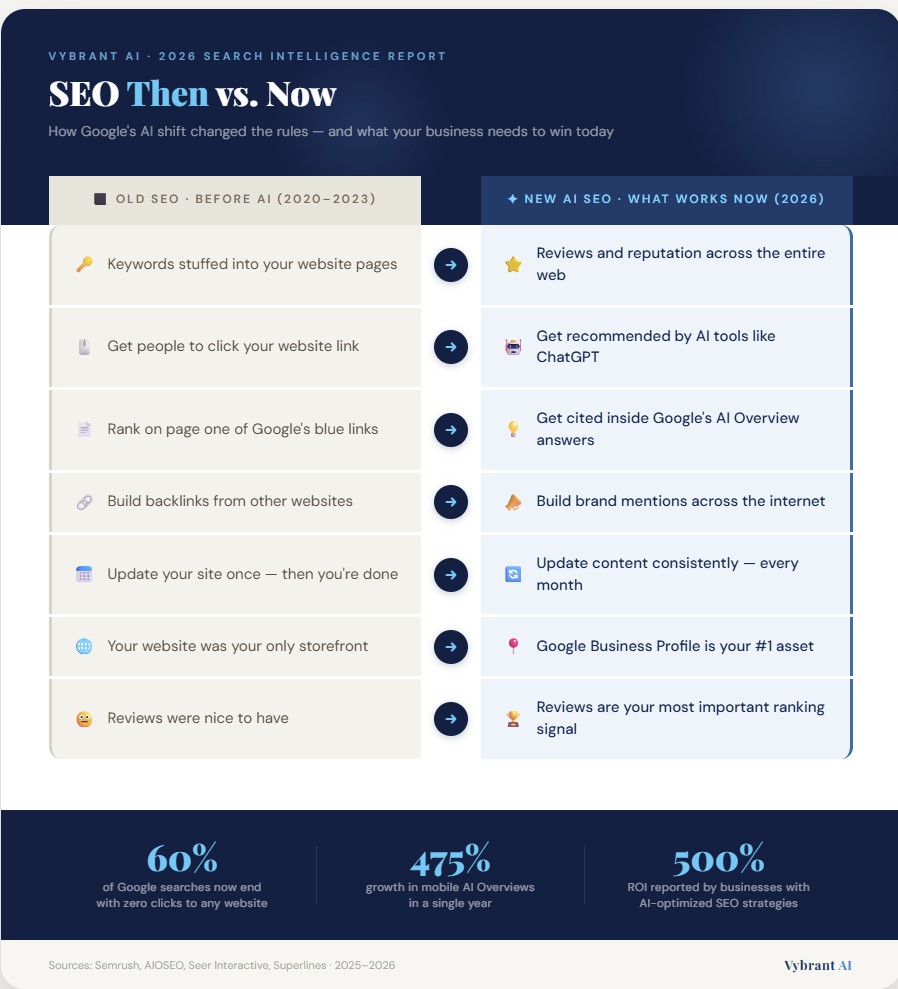
Reviews — lots of them, and recent ones
Google pays close attention to how many reviews you have, how recent they are, and what star rating you carry. A business with 200 reviews and a 4.8 average beats a competitor with 40 old reviews almost every time in local search results. 74% of small businesses now invest in SEO, and review management is one of the highest-return components of that investment. (AIOSEO, 2026)
Consistent and complete business information
Your business name, address, phone number, website, and hours need to be the same everywhere they appear online — Google, Yelp, Facebook, Apple Maps, Bing, everywhere. Inconsistent information confuses Google and hurts your ranking. This sounds simple but it is one of the most common problems small businesses have.
A fast, mobile-friendly website
92.3% of all internet users access the web from a phone. (AIOSEO, 2026) If your website loads slowly on a phone or is hard to read on a small screen, Google penalizes you in the rankings. Speed and mobile performance are direct ranking factors — not nice-to-haves.
Content that answers real questions
Blog posts, service pages, and FAQ sections that answer the real questions your customers ask are increasingly important — not just for traditional search but for getting cited by AI tools. Content updated within the last three months gets twice as many AI citations as older content. (SE Ranking, 2025) Google and AI tools both reward businesses that consistently provide helpful, current information.
Being mentioned and recommended across the web
YouTube mentions and branded web mentions — people talking about your business by name — have the strongest correlation with AI search visibility of any factor studied. (SEOmator, 2026) This means your reputation across the entire internet, not just your own website, determines how much AI tools trust and recommend your business.
What I Learned Running My Own Salon in Los Angeles
I want to share something personal here, because everything I just described is something I lived through firsthand running Gloss & Glam in Los Angeles.
Los Angeles is one of the most competitive cities in the world for a hair salon. There are thousands of us. A new salon opens every week. And customers have endless options. So when I noticed that the way people were finding us was changing — when I started seeing that Google was showing different things at the top of search results — I paid close attention.
What I found was this: the salons showing up at the top of local Google results were not necessarily the best ones. They were the ones that had the most reviews, the most recent activity, the most consistent presence everywhere online. They had figured out how to signal to Google — and to AI tools — that they were trustworthy, active, and worth recommending.
One example that stuck with me: a client came in and told me she had specifically chosen Gloss & Glam because when she asked ChatGPT for a hair treatment recommendation in our area, our name came up. Not because we paid for it. Not because we had the fanciest website. Because we had built up enough of a presence — reviews, consistent information, content, online mentions — that an AI decided we were worth recommending.
That was the moment I fully understood what was changing. SEO in 2026 is not about tricking Google with keywords. It is about building the kind of real, documented reputation that Google and AI tools trust enough to put in front of people who are ready to spend money.
“A client told me she found Gloss & Glam because ChatGPT recommended us. Not because of ads. Because we had built the kind of online presence that AI trusts. That’s the new SEO.” — Shawn Shayestehfar, Founder, Vybrant AI
The 5 Biggest SEO Mistakes Small Businesses Make Right Now
After working with local service businesses across multiple industries, the same mistakes show up over and over again. These are not small mistakes. Each one is quietly costing businesses real customers every single week.
Mistake 1: Ignoring Google Business Profile
Your Google Business Profile is the single most important piece of online real estate you have for local search. It is the box that shows up on Google Maps and in local search results with your rating, photos, hours, and reviews. Businesses that do not actively manage this profile — adding photos, updating hours, responding to reviews, posting updates — fall behind competitors who do. This is not optional anymore. It is the foundation of local SEO.
Mistake 2: Not collecting reviews consistently
Google weights the recency of reviews heavily. A business with 50 reviews but none in the last four months looks stale compared to a competitor with 30 reviews and three new ones this week. Happy customers rarely leave reviews on their own — they need to be asked at the right moment. Most small businesses either never ask or ask inconsistently. The result is a review profile that slowly loses ground to competitors who have automated this process.
Mistake 3: Having different business information in different places
If your phone number on Google says one thing and your number on Yelp says something slightly different — maybe an old number, or a different format — Google sees a discrepancy. If your hours on Facebook do not match your hours on Google, Google does not know which one to trust. These small inconsistencies send a signal of unreliability that hurts your rankings. Every place your business is listed online needs to say the exact same thing.
Mistake 4: A website that is slow or hard to use on a phone
If your website takes more than three seconds to load on a phone, a large percentage of visitors leave before they ever see your content. And Google knows this happens — it tracks how quickly people leave your site and uses that as a ranking signal. A slow, clunky website tells Google your site is not worth recommending. A fast, clean, easy-to-use website tells Google the opposite.
Mistake 5: No content strategy — just a website that never changes
A website that was built three years ago and has never been touched since is, in Google’s eyes, a website that has been abandoned. Active businesses have active websites — new blog posts, updated service pages, fresh content that signals to both Google and AI tools that this business is alive, expert, and worth paying attention to. Thought leadership blogs with relevant keywords have a 748% ROI according to AIOSEO’s 2026 data. Content is not optional. It is one of the highest-return investments a small business can make.
What the Best-Performing Local Businesses Are Doing Differently
The businesses that are growing their visibility in 2026 — showing up in Google local results, getting recommended by AI tools, and converting that visibility into real booked appointments and customers — are not doing anything magic. They are doing specific things consistently that most of their competitors are not.
They treat their online reputation as a business asset, not an afterthought. They collect reviews systematically after every customer interaction. They respond to every review — the good ones and the bad ones — because they understand that future customers are reading those responses and making decisions based on them.
They make sure their business information is correct and complete everywhere it appears online. They keep their Google Business Profile updated with fresh photos, current hours, and regular posts. They make sure their website loads fast on a phone.
They create content that answers the real questions their customers ask. Not to stuff keywords into Google, but because genuinely helpful content is what both Google and AI tools now reward most. A pest control company that has a blog post answering “is pest control safe for my pets?” is showing up in AI recommendations when someone asks that question. A salon that has content explaining “how long does a balayage take?” is getting found by people at the exact moment they are deciding where to book.
Most importantly, they do all of this consistently — not in one burst and then nothing for six months. Consistency is what separates the businesses Google trusts from the ones it overlooks.
And here is the reality: doing all of this well, across every platform, every week, while also running a business and serving customers, is a lot. It requires the right tools, the right strategy, and — if you want it to actually work — experienced people who do this every day.
Why This Is Harder Than It Looks — And Why Getting Help Pays Off
Small business owners are some of the most capable, hard-working people in the world. But SEO and AI search visibility is a specialty — just like accounting, legal work, and plumbing. You would not wire your own electrical panel to save money. You would not do your own taxes if the stakes were high enough. And increasingly, your online visibility is high-stakes enough to treat the same way.
The businesses that are winning in local search right now are not doing it alone. They have systems — often AI-powered — that handle review generation, reputation monitoring, content creation, and local SEO maintenance automatically. They have experts who understand how Google’s algorithm is changing and can adjust strategy before their rankings drop, not after.
The average small business spends $497 per month on SEO services. (AIOSEO, 2026) But the difference in outcome between a well-executed strategy and a poorly executed one is not small — it is the difference between showing up on page one of Google or page three. It is the difference between being the salon ChatGPT recommends or the one that never gets mentioned. It is the difference between a full schedule and a quiet phone.
Companies seeing strong returns from AI-optimized SEO strategies are reporting 300-500% ROI within 6-12 months. (Superlines, 2026) That is not a guarantee — results depend entirely on strategy quality and execution. But it illustrates the gap between businesses that take this seriously and the ones that treat their online presence as something to deal with later.
At Vybrant AI, this is exactly what we built the platform to address. We work with local service businesses — salons, home service companies, retail shops, wellness businesses — to build the kind of AI-ready online presence that gets found in both Google search and AI-generated recommendations. Review generation. Reputation management. Local SEO. Content strategy. All of it coordinated in one place, built specifically for small businesses that do not have a marketing department but still need to compete like they do.
“Companies with AI-optimized SEO strategies are reporting 300-500% ROI within 6-12 months. The gap between businesses that take this seriously and the ones that don’t is measurable — and it is growing.”
What Happens If You Wait?
This is the question worth sitting with for a moment.
SEO is not like running an ad. An ad turns on and off. SEO builds over time — which means businesses that start now are building an advantage that compounds. Every week of reviews collected, every piece of helpful content published, every business listing cleaned up — it all stacks. The business that started six months ago has a six-month head start that is genuinely hard to close.
The reverse is equally true. Every month of inactivity — reviews not collected, content not published, a Google Business Profile sitting unchanged — is a month your competitors are pulling ahead. Not dramatically, not overnight. But steadily. And by the time the gap becomes obvious in your booking numbers, it has been building for a long time.
By the end of 2026, experts project that 25% of traditional Google searches will disappear entirely as people shift to asking AI tools directly. (Incremys, 2026) The businesses that have built their AI search visibility now will be the ones getting those recommendations. The ones that waited will be chasing a moving target.
The search landscape has already changed. The businesses adapting to that change right now are the ones that will still be growing in two years. The question is simply whether your business is going to be one of them.
If you want to see where your business stands right now — how you appear in local search, what AI tools are saying about you, and what the biggest gaps are — the first step is a simple conversation. That is what we do at Vybrant AI, and it starts with a free demo where we show you exactly what we are seeing so you can make an informed decision.
Want to Know How Your Business Shows Up in AI Search Right Now?
Vybrant AI works with local service businesses to build the kind of online presence that gets found — in Google, in AI tools like ChatGPT, and everywhere customers are searching. We handle the reviews, the reputation, the content, and the local SEO so you can focus on running your business.
Book a free demo at vybrant.ai and see exactly where you stand — and what it would take to get to the top.
Frequently Asked Questions About AI and SEO for Small Business
What is AI SEO?
AI SEO refers to the practice of optimizing your business’s online presence to be found not just by traditional Google search but also by AI tools like ChatGPT, Google’s AI Overviews, and Perplexity. It includes making sure your content is structured in a way AI systems can read and cite, building a strong review profile, and ensuring your business information is consistent and trustworthy across the entire internet.
What is Google AI Overviews and how does it affect my business?
Google AI Overviews is a feature that uses artificial intelligence to write a summary answer at the very top of Google search results — above all other links and ads. For businesses selling products or providing general information, this can reduce website traffic because people get their answer without clicking anything. However, for local service businesses, AI Overviews appear on only about 7.9% of local searches, meaning businesses that show up in the local map pack and Google Business Profile results are largely insulated from this shift.
Why is my website traffic dropping even though my ranking hasn’t changed?
This is one of the most common and confusing things happening to small business websites right now. Organic click-through rates have dropped 61% on searches where AI Overviews appear. Even searches that do not trigger AI Overviews are seeing CTR declines. You might be ranking in the same position you always were, but fewer people are clicking because AI-generated summaries and other Google features are answering their questions before they need to visit your site. The solution is not to chase rankings — it is to ensure your business appears in the places where high-intent customers are still clicking: local map packs, Google Business Profile, and AI recommendations.
How does AI search like ChatGPT find and recommend local businesses?
AI tools like ChatGPT learn from enormous amounts of web content — reviews, business listings, blog posts, news mentions, and social media. When someone asks ChatGPT to recommend a salon, plumber, or pest control company in a specific area, the AI surfaces businesses that have a strong, consistent presence across these sources. The factors with the strongest correlation to AI recommendations are: branded web mentions, YouTube mentions, consistent business information across directories, review volume and quality, and informative content on your website. Businesses with thin or inconsistent online presences rarely get recommended.
Is SEO still worth investing in for small businesses in 2026?
Yes — but the definition of SEO has expanded. Traditional SEO (keywords, backlinks, technical website optimization) is still the foundation. But in 2026, a complete small business SEO strategy also includes reputation management, AI search visibility, Google Business Profile optimization, and content that gets cited by AI tools. Companies with well-executed AI-optimized SEO strategies are reporting 300-500% ROI within 6-12 months. SEO is not dead. It has evolved — and the businesses that evolve with it are seeing stronger results than ever.
What is E-E-A-T and why does Google care about it?
E-E-A-T stands for Experience, Expertise, Authoritativeness, and Trustworthiness. It is the framework Google uses to evaluate whether a business or website is worth sending searchers to. Experience means demonstrating real firsthand knowledge — a salon owner writing about hair care, not a generic article writer. Expertise means showing depth of knowledge in your field. Authoritativeness means being recognized and referenced by other trusted sources. Trustworthiness means accurate information, consistent business details, real reviews, and a secure website. For local businesses, building strong E-E-A-T signals is one of the most effective long-term SEO investments available.
How long does it take to see results from local SEO?
For local SEO specifically, some improvements — like a fully optimized Google Business Profile, consistent directory listings, and a fresh batch of reviews — can impact your visibility within 4-8 weeks. Longer-term gains from content strategy, domain authority building, and AI search visibility typically show meaningful results within 3-6 months. The key is consistency: businesses that maintain their SEO activity every month see compounding results over time, while businesses that treat it as a one-time project typically plateau or decline.
What is the difference between traditional SEO and AI SEO?
Traditional SEO focuses on ranking your website in Google’s blue link results through keywords, backlinks, technical website performance, and content quality. AI SEO adds a layer focused specifically on being visible in AI-generated answers — making sure your content is structured in a way AI systems can read and cite, that your brand is mentioned across trusted sources online, and that your business appears in the conversational recommendations AI tools give when someone asks them for local business suggestions. In 2026, both matter — they work together rather than replacing each other.
Do I need to be a tech expert to manage my business’s SEO?
No — but you do need the right tools or the right partner. The complexity of managing local SEO, AI search visibility, review generation, and content strategy simultaneously is real, and trying to do it all manually while running a business is genuinely difficult. Most successful small businesses either use an AI-powered platform that automates the bulk of the ongoing work, work with a specialist who manages it for them, or both. The key is not learning to be an SEO expert yourself — it is getting a system in place so it happens consistently without requiring your constant attention.
How does Vybrant AI help small businesses get found online?
Vybrant AI is a platform built specifically for local service businesses that combines AI-powered review generation, reputation management, local SEO optimization, and content strategy in one place. Rather than managing five different tools and trying to coordinate a complex strategy manually, Vybrant AI brings it all together — automated review requests after every customer interaction, AI-assisted response management, local listing consistency monitoring, and content that builds the E-E-A-T signals Google and AI tools look for. The platform was built by a small business owner — Shawn Shayestehfar of Gloss & Glam Hair Salon in Los Angeles — who experienced firsthand how these systems work and what actually moves the needle for local businesses competing in crowded markets.
About the Author
Shawn Shayestehfar
Founder, Vybrant AI | Owner, Gloss & Glam Hair Salon and Head Spa, Los Angeles
Shawn Shayestehfar is the founder of Vybrant AI and owner of Gloss & Glam Hair Salon and Head Spa in Los Angeles. As a small business owner competing in one of the most saturated service markets in the country, Shawn has navigated every change Google has thrown at local businesses over the years — from the rise of mobile search to the arrival of AI Overviews — and built Vybrant AI as a direct response to what he saw local businesses struggling with most. The platform exists because Shawn lived these problems firsthand and wanted to build tools that actually solve them for businesses that compete on craft and service, not marketing budgets.
Sources
Semrush, AI Overviews Study: 10 Million Keywords Analyzed, 2026. semrush.com
Seer Interactive, AIO Impact on Google CTR: September 2025 Update. seerinteractive.com
Ahrefs, AI Overviews Local Search Impact, November 2025. ahrefs.com
AIOSEO, 85+ SEO Statistics for 2026. aioseo.com
SEOmator, 30+ AI SEO Statistics for 2026. seomator.com
SE Ranking, Content and AI Citation Analysis, November 2025. seranking.com
Search Engine Land, AI Platform Referral Traffic Report, 2025. searchengineland.com
Position Digital, 100+ AI SEO Statistics for 2026. position.digital
Superlines, AI Search Optimization ROI Study, 2026. superlines.com
Incremys, Future of Search Projections, 2026. incremys.com
Growth Memo, AI Citation Analysis February 2026. growthmemorando.com
WordStream, Google AI Overviews Statistics, 2026. wordstream.com
seoClarity, Impact of Google AI Overviews Research Study, 2025. seoclarit